Wellbeing is a journey. We'd love to walk it with you.
Each individual carries a unique combination of needs shaping their wellbeing. Whatever stage you're at, there's a next small step worth taking.


What actually moves the needle.
Some people seem to have a greater sense of wellbeing than others. Why? And what can the rest of us learn from them?
"Wellbeing" is increasingly used as a synonym for "happiness", but the two aren't quite the same. Wellbeing covers physical and psychological health, the quality of relationships between yourself and others, your sense of purpose and meaning, and even your financial situation.
Research has identified several things that meaningfully impact your wellbeing — and the good news is they're all within reach. These include practising gratitude, adopting a solution-focused mindset, and strengthening your sense of belonging and purpose.
Gratitude is probably the single biggest thing you could learn to positively impact your wellbeing. It's been shown to improve mood, immunity and sleep. Being thankful changes our brain chemistry — and it's both addictive and infectious.
Focusing on solutions rather than problems is critical to maintaining our wellbeing. Challenges are part of life, but shifting gear to think creatively about how to resolve them is empowering. It also gives you a framework to move through the situation quickly and effectively.
Fundamental to your sense of wellbeing is your support system: family, friends and those you share a sense of purpose with. Belonging to a group makes us feel valued, welcome, accepted and secure. Finding people who share your values dramatically increases your sense of wellbeing.
"Your wellbeing is a journey, and we'd love to be part of it."
Become an Affiliate


Reimagining Inclusion
Inclusive Education Teacher Arwa Naif On Moving Beyond Awareness To Real Change
As an inclusive education teacher at Glenwood High School, Arwa Naif has witnessed first-hand how diversity and inclusion efforts have evolved over the past decade. “I have seen more initiatives happening that bring awareness of diversity in our community and champion inclusion,” she explains. “This is mostly based around the acknowledgment and celebration of certain days, for example, Harmony Day, Wear it Purple, and Autism Awareness.”
While these efforts help educate communities about the diverse populations within them, Arwa believes they haven’t yet translated into true equity for those groups. “I do not see this leading to equitable outcomes for those groups because the education system remains rigid and largely inflexible in the way of structure, delivery, and expectations,” she reflects. “The modality by which we learn and grow has not been re-imagined since the advent of formalised and mandatory schooling.”
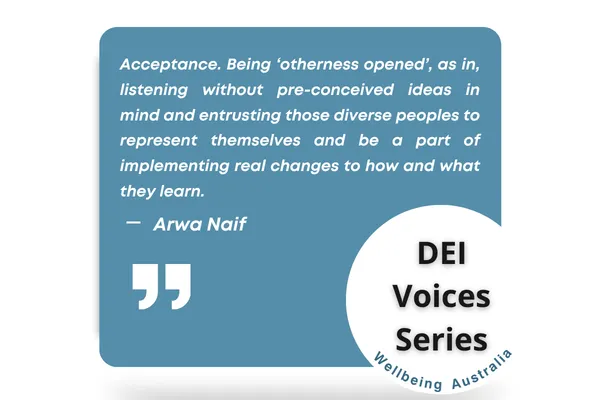
For Arwa, meaningful change requires leaders to practice a deeper kind of acceptance – to approach diversity without preconceived notions and to genuinely listen. “Being ‘otherness opened,’ as in listening without preconceived ideas in mind and entrusting those diverse peoples to represent themselves and be a part of implementing real changes to how and what they learn,” she says.
Looking ahead, Arwa sees a clear path forward for institutions – workplaces, schools, and universities alike. “These institutions could adopt clear values around acceptance and tolerance. Focusing less on productivity and more on finding common ground; a solid foundation from which creativity and development can flourish,” she suggests. “Making room for self-expression disarms boundaries and allows for a flow of communication that culminates in shared vision and brave, new environments.”
Her insights remind us that true inclusion goes beyond awareness days or token gestures. It calls for courage to rethink long-standing systems, to listen openly, and to create spaces where every individual is truly seen, valued, and empowered to shape their own experience. Inclusion isn’t about simply adding diverse materials or hosting annual celebrations – it demands a fundamental reimagining of the system itself: its structures, values, and the power dynamics that shape it.
✅ DEI is not just a topic to discuss; it’s a lens through which we must view how we teach, learn, and lead.
✅ Inclusion cannot be a superficial effort; it must be woven into the very foundation of our institutions.
✅ Equity doesn’t arise from staying comfortable – it requires courage to challenge the status quo and create meaningful change.
Arwa reminds us that this journey is complex and ongoing, but it’s only by embracing this challenge wholeheartedly that education can fulfil its promise as a space of belonging, opportunity, and growth for all.
✨ This post is part of our DEI Voices Series – exploring how inclusion is experienced (and challenged) across industries and identities. If you found this article insightful, please share it to help spread these important conversations.
We acknowledge the Traditional Owners of Country throughout Australia. We pay our respects to Elders past and present. We recognise the First Peoples of this Nation and their ongoing cultural and spiritual connections to the lands, waters, seas, skies and communities.
LINKS
STAY CONNECTED


Copyright 2026. Wellbeing Australia. All Rights Reserved.