
Wellbeing is a journey. We'd love to walk it with you.
Each individual carries a unique combination of needs shaping their wellbeing. Whatever stage you're at, there's a next small step worth taking.


What actually moves the needle.
Some people seem to have a greater sense of wellbeing than others. Why? And what can the rest of us learn from them?
"Wellbeing" is increasingly used as a synonym for "happiness", but the two aren't quite the same. Wellbeing covers physical and psychological health, the quality of relationships between yourself and others, your sense of purpose and meaning, and even your financial situation.
Research has identified several things that meaningfully impact your wellbeing — and the good news is they're all within reach. These include practising gratitude, adopting a solution-focused mindset, and strengthening your sense of belonging and purpose.
Gratitude is probably the single biggest thing you could learn to positively impact your wellbeing. It's been shown to improve mood, immunity and sleep. Being thankful changes our brain chemistry — and it's both addictive and infectious.
Focusing on solutions rather than problems is critical to maintaining our wellbeing. Challenges are part of life, but shifting gear to think creatively about how to resolve them is empowering. It also gives you a framework to move through the situation quickly and effectively.
Fundamental to your sense of wellbeing is your support system: family, friends and those you share a sense of purpose with. Belonging to a group makes us feel valued, welcome, accepted and secure. Finding people who share your values dramatically increases your sense of wellbeing.
"Your wellbeing is a journey, and we'd love to be part of it."
Become an Affiliate


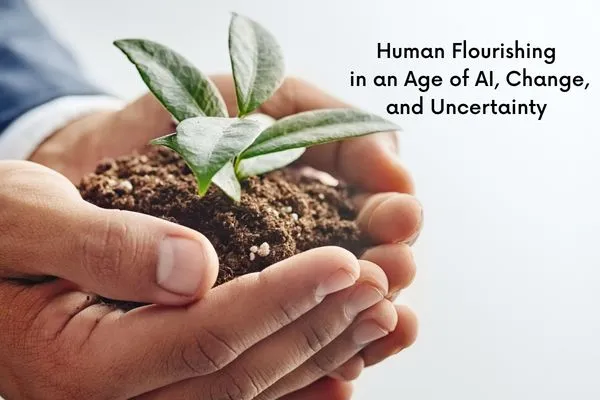
Human Flourishing in an Age of AI, Change, and Uncertainty
As technology grows more capable, the challenge is not only to ask what AI will change, but what kind of human beings our schools are helping young people to become.
Artificial intelligence is changing how we work, learn, create and communicate. Tasks that once required considerable human expertise can now be completed, or assisted, in seconds. For schools, this creates practical challenges. What should students learn? How should assessment change? When does AI support learning, and when does it replace the thinking a task was designed to develop?
Beneath these concerns sits a deeper issue: what does it mean to flourish as a human being in a world shaped by intelligent machines, rapid change and uncertainty? Throughout this series, I have described flourishing as richer than happiness, achievement or wellbeing alone. It includes meaning and purpose, belonging, agency, contribution and the capacity to navigate both the joy and difficulty of being human. Education has always shaped the people young learners are becoming. AI gives fresh urgency to that responsibility.
Flourishing asks us to look beyond what technology can do and consider what it is doing to us. Are people becoming more connected or more isolated? Do they have greater agency, or less? Is technology helping us live with greater purpose, dignity and meaning?
Recent work by Tyler VanderWeele and Jonathan Teubner from the Human Flourishing Program at Harvard supports this approach. They argue that AI should be judged partly by whether it promotes or impedes human flourishing, including its effects on knowledge, relationships and our development as persons. That changes the question from What can this technology do? to What is it helping us become?
One temptation in responding to AI is to define human value according to whatever machines cannot yet do. Once technology performs one task well, we move to another and declare that this is where our uniqueness lies. Human worth cannot depend on being more productive, more efficient or faster at processing information than a machine. Nor can education keep redefining its purpose around whatever technology has not yet mastered.
A better starting point is: What is worth cultivating in a human life, regardless of what technology becomes capable of doing? Wisdom, creativity, empathy, relationships, moral judgement, purpose and compassion matter because they contribute to lives that are meaningful, responsible and deeply human.
Education must equip young people with knowledge and technological capability. Schools are rightly accountable for learning. We can assess literacy more readily than wisdom, but that does not make wisdom less important.
AI gives students extraordinary access to information, yet having an answer and understanding an answer are different things. Imagine a student who submits a response written largely with AI. The argument is coherent and the structure impressive. Then the teacher asks, ‘Do you agree with the argument?’
Producing an answer is not the same as developing judgement. Wisdom requires us to interpret what we know, recognise what deserves attention, consider consequences and decide between competing possibilities. As answers become easier to generate, schools will need to place greater emphasis on questioning, evaluating and discerning.
AI can generate ideas for a story, design an image or produce music. Yet creativity involves imagination, curiosity, experimentation and the willingness to stay with something that does not work the first time. There is educational value in the false start and the moment when a learner suddenly sees something differently.
Purpose takes us beyond capability. Young people deserve opportunities to ask: What am I contributing to? Where can I make a difference? What responsibilities do I carry towards others? What kind of life do I want to build? Those concerns become more important when the future feels uncertain. Flourishing does not require every answer in advance. It involves moving forward amid ambiguity, revising our thinking when circumstances change and remaining grounded in what we value.
Flourishing also reminds us that relationships are not secondary. Much of what matters most in education is inefficient. A teacher notices that a normally animated student has become quiet and pauses to check in. A colleague realises that someone who usually manages everything is struggling and stays behind to talk. A student encounters an adult who listens before trying to solve the problem. These moments rarely appear in strategic plans or achievement data, yet they can be among the moments people remember longest.
If AI reduces unnecessary administration and returns time to teachers for human interaction, that is a worthwhile gain. The danger arises when speed, convenience and efficiency begin to shape our expectations of people. Listening takes time. Trust takes time. Friendship takes time. Flourishing does too.
Empathy helps us recognise something from another person's experience. Compassion asks us to respond, and compassion sometimes requires us to be interrupted. A teacher stops because a student needs to talk. A colleague changes plans because someone needs support. Those interruptions are not failures of efficiency. They are part of what makes a school a human community.
We do not flourish alone.
AI also creates choices that technological competence alone cannot resolve. When does assistance become dependent? If an automated system recommends a course of action for a student, who remains responsible?
Human accountability should remain visible. Technology can inform a decision, but the person making it still needs to consider the individual student, weigh the consequences and stand behind the decision. Accuracy cannot settle every concern. A recommendation can be technically effective while still raising questions about fairness, privacy, dignity or whose interests are being served.
A flourishing perspective asks us to look beyond whether something works and consider whether it helps people live well. For schools, AI literacy must extend beyond competent tool use. Young people need opportunities to consider who may be affected, what values are at stake and what responsibility remains theirs.
Powerful tools increase what we can do. Education must also help young people decide what they should do.
There is much to welcome about artificial intelligence. Used wisely, it could widen access to knowledge, support creativity, reduce repetitive work and open possibilities we have not yet imagined. But technological progress does not guarantee human flourishing.
Wisdom, strong relationships and moral judgement will matter just as much as technological capability. Underneath all three sits purpose: some understanding of what our knowledge, creativity and capability are ultimately for.
These are not softer qualities left over once the serious learning has been completed. They belong within serious learning.
As this series on flourishing comes to an end, the challenge for schools is larger than preparing young people to use artificial intelligence well. It is about helping them become people who can flourish in its presence, live meaningfully, relate deeply and remain grounded when the future is uncertain.
The measure of progress cannot rest only on what our technology becomes capable of doing. It must also include what that technology is doing to us.
Ultimately, the future of AI is not the only future being shaped. So too is the future of human beings growing up alongside it.
Bibliography.
Murray, Andrew. 2026. Faith, Flourishing, and Well-being. Melbourne: Garratt Publishing.
VanderWeele, Tyler J., and Jonathan D. Teubner. 2026. “Flourishing Considerations for AI.” Information 17 (1): 88. https://doi.org/10.3390/info17010088
THE HUMAN FLOURISHING SERIES EXPLORING EDUCATION, LEADERSHIP, AND HUMAN POTENTIAL. - PART 4 OF 4

We acknowledge the Traditional Owners of Country throughout Australia. We pay our respects to Elders past and present. We recognise the First Peoples of this Nation and their ongoing cultural and spiritual connections to the lands, waters, seas, skies and communities.
LINKS
STAY CONNECTED


Copyright 2026. Wellbeing Australia. All Rights Reserved.