Wellbeing is a journey. We'd love to walk it with you.
Each individual carries a unique combination of needs shaping their wellbeing. Whatever stage you're at, there's a next small step worth taking.


What actually moves the needle.
Some people seem to have a greater sense of wellbeing than others. Why? And what can the rest of us learn from them?
"Wellbeing" is increasingly used as a synonym for "happiness", but the two aren't quite the same. Wellbeing covers physical and psychological health, the quality of relationships between yourself and others, your sense of purpose and meaning, and even your financial situation.
Research has identified several things that meaningfully impact your wellbeing — and the good news is they're all within reach. These include practising gratitude, adopting a solution-focused mindset, and strengthening your sense of belonging and purpose.
Gratitude is probably the single biggest thing you could learn to positively impact your wellbeing. It's been shown to improve mood, immunity and sleep. Being thankful changes our brain chemistry — and it's both addictive and infectious.
Focusing on solutions rather than problems is critical to maintaining our wellbeing. Challenges are part of life, but shifting gear to think creatively about how to resolve them is empowering. It also gives you a framework to move through the situation quickly and effectively.
Fundamental to your sense of wellbeing is your support system: family, friends and those you share a sense of purpose with. Belonging to a group makes us feel valued, welcome, accepted and secure. Finding people who share your values dramatically increases your sense of wellbeing.
"Your wellbeing is a journey, and we'd love to be part of it."
Become an Affiliate



The Space Between Potential and Possibility
Written by Joyce Kattunilath
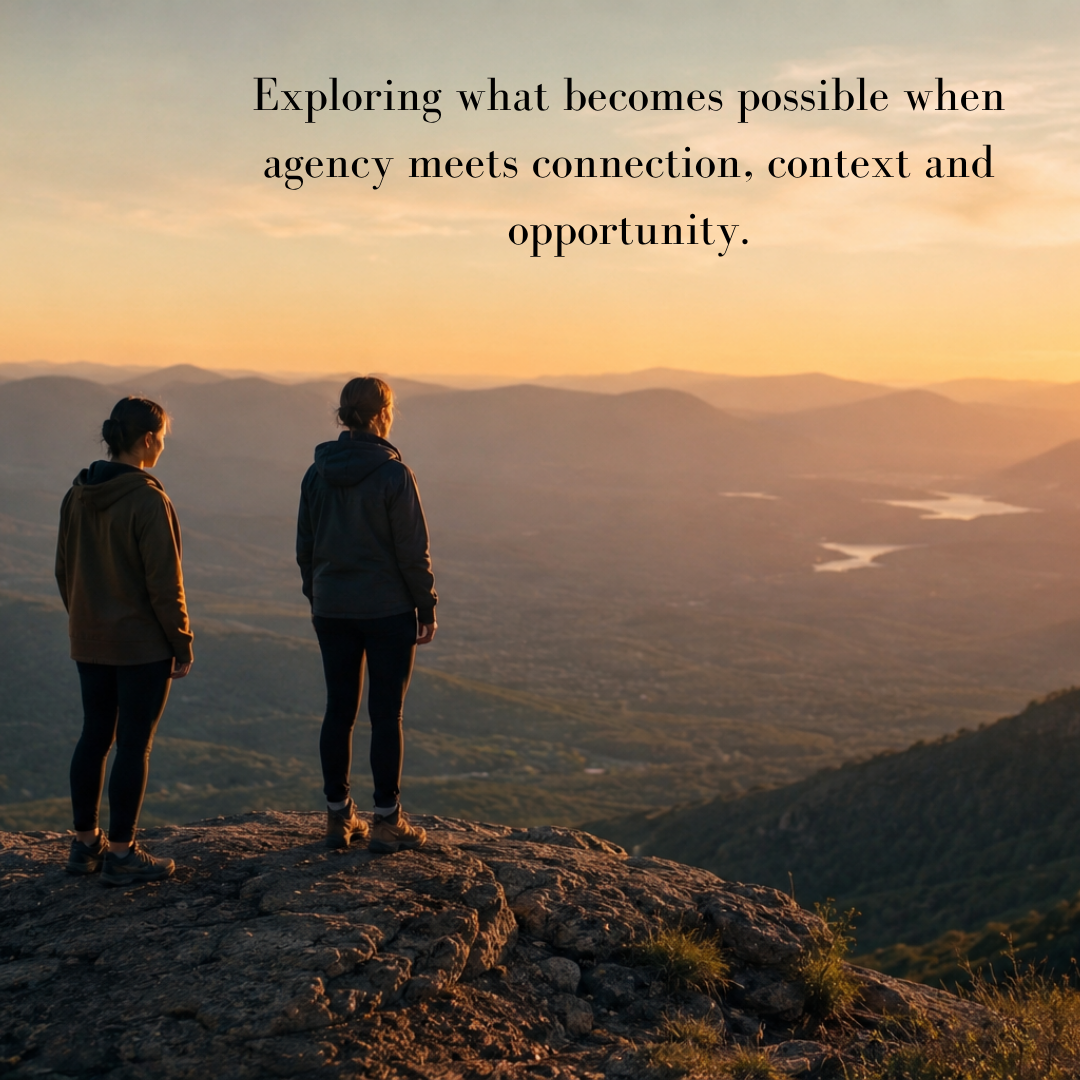
Human potential is not what we can achieve alone, but what becomes possible when we are supported by others.
We have spent a great deal of time thinking about potential as something located within the individual. We talk about talent, capability, motivation, resilience, mindset and agency, as though these are qualities a person carries with them and can draw upon regardless of context. There is some truth in this. People do have agency. We make choices, take risks, learn, persist and sometimes change the circumstances we find ourselves in. But agency has never meant that we operate independently of the world around us. Our capacity to act is always exercised within relationships, institutions, cultures and material conditions that can either enlarge what is possible or narrow it.
This matters because there is a subtle difference between asking what a person is capable of and asking what is possible for that person in the conditions in which they are living. The two are not the same. A person can possess considerable intelligence and have little opportunity to use it. They can be deeply creative in an environment that has no tolerance for experimentation. They can have courage and still remain silent when the consequences of speaking are too high. They can be highly resilient and yet spend so much of their energy adapting to an unhealthy environment that there is very little left for growth. We are often quick to interpret the outcome as a reflection of the individual without examining the conditions that helped produce it.
This is also where the way we talk about wellbeing starts to feel inadequate. We have become accustomed to separating wellbeing into categories: mental, physical, emotional, social, financial, because categories make complex things easier to measure, organise and intervene in. But the human experience itself does not arrive in categories. A relationship can affect our physical health. Financial insecurity can alter our emotional and cognitive capacity. A sense of belonging can change the risks we are willing to take. Meaning can affect our energy and our ability to recover. The quality of an environment can influence whether we experience ourselves as capable or constantly inadequate. What happens in one part of our lives is continually carried into another.
The problem is not that these dimensions are irrelevant, but that we can mistake useful distinctions for separate realities. The map can become more important than the territory. We assess the parts and then wonder why improving the parts does not necessarily produce a healthier whole.
A more holistic view asks us to look at the relationships between things rather than simply the things themselves. It asks what happens when individual agency meets social support, when capability meets opportunity, when aspiration meets trust, and when a person's willingness to act meets a culture that either welcomes or constrains that action. Human potential is less like a fixed capacity waiting to be unlocked and more like something that emerges through these interactions.
This does not diminish agency. In fact, it gives agency a richer meaning. Agency is not simply the ability to cope alone. It includes the ability to influence our circumstances, to ask for help, to form relationships, to shape environments and, importantly, to shape the conditions in which other people can exercise their own agency. We are not powerless in the face of our environments, but neither are we independent of them.
This is why support should not be understood simply as something we provide when an individual is struggling. The presence of another person can fundamentally alter what someone is able to see, attempt, tolerate and become. A trusted colleague can make it possible to voice an idea that would otherwise remain unspoken. A mentor can expand someone's sense of what is within reach. A team can distribute the cognitive and emotional load that would make an individual effort unsustainable. A community can create the conditions in which people are willing to participate, contribute and take risks they might not take alone. In each case, something becomes possible that was not as readily possible in isolation.
There is a broader implication here for how we think about leadership, education, organisations and society. If we are genuinely interested in human potential, then our responsibility cannot stop at developing individuals. We also have to pay attention to the environments we create around them. We have to ask whether our cultures produce agency or dependency, whether our systems create opportunity or merely demand resilience, and whether the relationships within them give people enough trust to use the capabilities they already possess.
Our attention needs to move beyond making individuals more resilient or more capable and towards creating conditions in which people can use their agency well, develop their capabilities and contribute to something larger than themselves.
If that is true, human flourishing cannot be understood entirely through the individual. What happens within a person is continually shaped by what happens around them, by the quality of their relationships, the opportunities available to them, the cultures they inhabit and the conditions in which they are expected to live, work and belong.
There is a tension here that is worth holding rather than resolving. We are responsible for ourselves, and we are profoundly dependent on one another. We have agency, and our agency is shaped by context. We can change our circumstances, and circumstances can change what we believe is possible. We can develop ourselves, but we also become through our relationships with others.
Human potential is not simply what resides within us. It is also found in the space between us: in the relationships that expand our sense of what is possible, in the environments that give our capabilities somewhere to go, and in the collective conditions we create for one another.
That shifts the question from how well individuals can stand alone to what becomes possible when people have both the agency to shape their lives and the relationships and conditions that allow that agency to matter.
A Note Beyond The Piece
I’m grateful for the conversations, questions, challenges and people that sit behind this piece. I don’t think our best thinking is ever entirely our own. An idea may begin with us, but it is rarely formed by us alone. It gets interrupted, stretched, questioned, contradicted and sometimes transformed by the people and experiences we encounter along the way.
Which makes me smile at the irony of writing about human potential as something that emerges between us.
Even this thought did.

We acknowledge the Traditional Owners of Country throughout Australia. We pay our respects to Elders past and present. We recognise the First Peoples of this Nation and their ongoing cultural and spiritual connections to the lands, waters, seas, skies and communities.
LINKS
STAY CONNECTED


Copyright 2026. Wellbeing Australia. All Rights Reserved.