A decade of championing wellbeing in education.
From childhood to adulthood, formal classrooms to lifelong learning — we've spent a decade making wellbeing a foundation, not an afterthought.


Where learning meets wellbeing.
A love of learning feeds knowledge, builds resilience, and gives shape to a life of meaning. Each stage of education brings its own demands — and its own gifts.
Wellbeing Australia has a ten-year legacy of championing proactive wellbeing practices across education at every stage of life. Childhood to adulthood. Pre‑school to apprenticeship. Tertiary to lifelong learning. We've seen what works, and we've seen what gets left behind when wellbeing isn't built in.
A love of learning is foundational to wellbeing. It feeds knowledge, supports us in responding to challenge, and gives shape to a sense of purpose. That passion for growth — in ourselves and in the people we teach — matters at every stage of development.
We recognise education in all its forms: pre‑school, school, tertiary education, apprenticeships and internships, practical learning, and the ongoing personal development that happens long after the last classroom. Each stage brings its own dynamics, demands and gifts.
Global research is clear: positive psychology has a dramatic impact within educational frameworks. Both here in Australia and overseas, we're seeing a growing commitment to positive structures in education — supporting students to build social, emotional and academic literacy that carries through every stage of life.
Whether you're a teacher, leader, support worker or parent, there's a place for you in this work. Affiliate membership gives you access to current research, customised webinars, practical resources and a community of educators committed to making wellbeing more than just a poster on a classroom wall.
“Wellbeing belongs in every classroom — not as an extra, but as a foundation.”
Become an Affiliate



Psychosocial Risk at Work: Governance, Legal Duties and Practical Compliance
Written by Niru Tyagi.
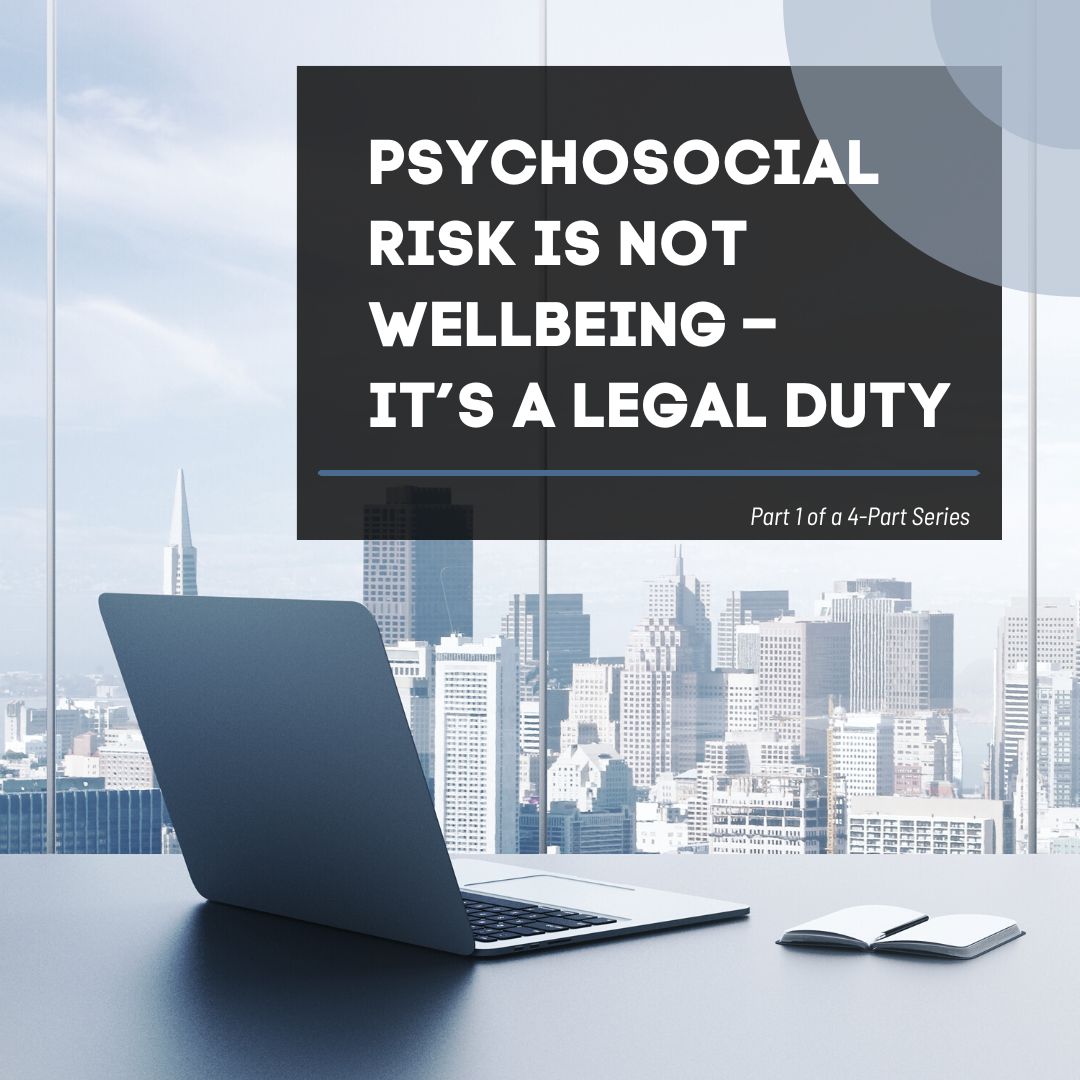
Part 1 of a 4-Part Series: PSYCHOSOCIAL RISK IS NOT WELLBEING – IT’S A LEGAL DUTY
Many employers in Australia invest in wellbeing programs such as yoga classes, mindfulness apps or free fruit. Those initiatives help people feel supported and may improve morale. They do not control the workplace factors that cause harm, such as excessive workload or bullying. Under Australian work health and safety (WHS) law, psychosocial risks must be managed with the same rigour as physical hazards (Australian Institute of Company Directors [AICD], 2024). This article explains the difference between wellbeing initiatives and psychosocial risk management, outlines legal obligations, and provides practical guidance for boards and executives.
Wellbeing Programs Versus Psychosocial Risk Management
Workplace wellbeing programs focus on individual health and morale. They might include counselling services, gym subsidies or mental health awareness days. While these efforts can help reduce stigma around mental illness, they do not address the hazards that cause psychological harm. Psychosocial hazards arise from the way work is designed and managed. Examples include high job demands, low control, unclear roles, bullying and harassment, poor physical conditions, and lack of recognition (AICD, 2024). These hazards can cause anxiety, depression, sleep disorders and even physical injuries. Managing psychosocial risk therefore means preventing harm at the source, not treating existing conditions.
In recent years, regulators across Australia have emphasised that managing psychosocial risks is not about treating mental health conditions. It is about eliminating or minimising hazards so far as reasonably practicable (AICD, 2024). By confusing psychosocial risk with wellbeing, some organisations fail to act on systemic hazards. For example, an organisation may offer mindfulness training while ignoring chronic understaffing, unrealistic deadlines or a bullying culture. Such an approach leaves workers exposed to ongoing harm and gives a false sense of compliance.
Psychosocial Risk as a Legal Obligation
Australia’s model WHS laws apply to both physical and psychological health. The primary duty of care requires persons conducting a business or undertaking (PCBUs) to ensure, so far as reasonably practicable, the health and safety of workers (Safe Work Australia, 2023). Officers, including directors and senior executives, must exercise due diligence to ensure that their organisation complies with this duty. Due diligence means taking reasonable steps to understand psychosocial hazards, ensuring resources and processes are in place to manage risks, and verifying that those processes are effective (AICD, 2024).
Different jurisdictions have introduced specific regulations and codes of practice for psychosocial risk. For example, Queensland’s 2022 amendments require written prevention plans for psychosocial hazards. Other states, such as Western Australia and the Australian Capital Territory, have codes of practice that set out how organisations should identify and control psychosocial risks. Regulators are dedicating more resources to enforcement. Boards and executives should expect that inspectors will ask for evidence of risk assessments, control measures and monitoring.
Consequences of Poor Psychosocial Risk Management
Failing to manage psychosocial hazards carries human and financial costs. Research commissioned by the EML Group and Monash University found that mental health‑related workers’ compensation claims have a median compensation cost of more than AUD 58,600 and a median time lost of over 34 weeks (EML & Monash University, 2025). That is more than four times the median cost and duration of physical injury claims. The data also show that mental health claims are rising, yet only a small fraction of workers with mental health conditions submit claims. This suggests that many workers suffer in silence or leave their jobs without formal claims.
Beyond compensation costs, unmanaged psychosocial hazards erode productivity, increase turnover and damage organisational culture. High job demands combined with low control and bullying reduce engagement and cause burnout. Workers who feel unsupported or unsafe may take sick leave or resign. Poor psychosocial safety also undermines the ability to attract and retain talent. The Productivity Commission estimates that mental ill-health costs the Australian economy more than AUD 70 billion each year (Productivity Commission, 2020). From a business perspective, investing in psychosocial risk management makes sense.
A System and Governance Issue
Psychosocial hazards result from organisational systems and decisions. Overwork, unclear roles and harmful behaviours reflect how work is planned and governed. The AICD emphasises that decisions at the board level influence how psychosocial risks are managed (AICD, 2024). Psychosocial incidents are often harder to spot and report than physical injuries. They can also escalate quickly if not addressed. Therefore, governance must embed psychosocial considerations into strategy, decision‑making and reporting.
Common psychosocial hazards include high job demands (workload, time pressure), low job control (little say in how tasks are done), lack of role clarity, poor organisational change management, inadequate reward or recognition, harmful behaviours (bullying, harassment), poor physical environments, and remote or isolated work (AICD, 2024). Frequent exposure to these hazards increases risk, but even a single traumatic event can cause lasting harm. For example, witnessing a workplace fatality or experiencing a serious customer assault can lead to post‑traumatic stress disorder.
Practical Steps For WHS Practitioners and Leaders
Organisations can move from wellbeing to hazard control by adopting the following practices:
Educate leaders on duties; Provide briefings on legal obligations, including the duty of care and due diligence requirements (AICD, 2024); Explain that psychological health is part of “health” under WHS laws and that psychosocial hazards must be managed like physical hazards; Encourage directors and executives to undertake training.
Identify hazards through consultation; Engage workers, health and safety representatives and unions to identify psychosocial hazards; Use surveys, focus groups, exit interviews and HR data to capture issues such as workload, bullying or poor role clarity; Remember that hazards can arise from job design, work environment, interpersonal relationships and governance.
Assess risks and prioritise controls; Evaluate the likelihood and potential severity of harm for each hazard; Prioritise hazards that are likely to cause serious harm or that affect large numbers of workers; Develop control measures that aim to eliminate or minimise hazards at the source, for example by redesigning jobs or improving staffing levels.
Integrate psychosocial risk into WHS systems; Include psychosocial hazards in risk registers, safety committees and reporting structures; Monitor metrics such as turnover, absenteeism, compensation claims and survey results; Use a Plan–Do–Check–Act cycle to continuously improve; Ensure that psychosocial safety is considered when planning changes to work design or technology.
Support workers and respond; Establish clear processes for reporting and responding to psychosocial incidents; Provide confidential complaint channels and protect workers from retaliation; Offer access to employee assistance programs and other support services; Investigate incidents thoroughly and focus on systemic causes rather than blaming individuals.
Hold leaders accountable; Assign responsibilities for psychosocial risk management at executive level; Include psychosocial safety metrics in performance evaluations; Ensure boards receive regular reports on psychosocial risk management; Conduct independent audits to verify that control measures are effective and that duties are met.
Psychosocial risk management is a core WHS duty in Australia. It is not a feel‑good wellness initiative. By confusing psychosocial risk with wellbeing, organisations may leave workers exposed to harm and face legal and reputational consequences. The law requires employers to identify, assess and control psychosocial hazards just as they do physical hazards. The data show that mental health injury claims are costly and lengthy. From a moral and business perspective, preventing harm through better work design and governance is the right thing to do. Boards and executives must lead the shift from perks to prevention by embedding psychosocial risk management into strategy, systems and culture.
References
Australian Institute of Company Directors. (2024).Governing WHS psychosocial risks: A primer for directors[1]. AICD.
EML Group & Monash University Healthy Working Lives Research Group. (2025).Inside the minds of Australia’s workplaces: Evidence, insight, and collective action for better mental health outcomes[2]. EML Group.
Productivity Commission. (2020).Mental health: Productivity Commission inquiry report. Commonwealth of Australia.
Safe Work Australia. (2023).Model WHS laws: guidance on psychological health. Safe Work Australia.
[1]governing-whs-psychosocial-risks-web
[2]EML_Mental-Health-White-Paper_Inside-the-Minds-of-Australias-Workplaces_WEB.pdf
About the Author
Niru Tyagi is a Psychosocial Risk and WHS Governance Strategist and founder of WHS Guard. She works at the intersection of governance, risk, and regulatory accountability helping boards and executive leaders build defensible psychosocial risk management systems aligned with ISO 45003 and Australia’s WHS legislative framework.
Specialising in complex and high-risk industries, Niru architects integrated governance systems that strengthen due diligence under the WHS Act (s 27) and the Corporations Act. Her work goes beyond policy. She designs measurable assurance structures, leading indicators, and board-level reporting frameworks that make psychosocial risk visible, auditable, and proactively managed.

We acknowledge the Traditional Owners of Country throughout Australia. We pay our respects to Elders past and present. We recognise the First Peoples of this Nation and their ongoing cultural and spiritual connections to the lands, waters, seas, skies and communities.
LINKS
STAY CONNECTED


Copyright 2026. Wellbeing Australia. All Rights Reserved.